
How we impact
act PROSPERI.AI
Act Digital Corporate Artificial Intelligence
Solutions
Services
Partners
SWIFT (Society for Worldwide Interbank Financial Telecommunication) is a global member-owned cooperative that provides secure financial messaging services to financial institutions worldwide. It facilitates fast, accurate, and secure communication for transactions, including payments, securities, and treasury operations.
The Customer Security Programme (CSP), launched by SWIFT in response to a wave of sophisticated cyberattacks before 2016, aimed to improve the cybersecurity posture of users worldwide. These complex and diverse cyber threats highlighted the critical need for a unified security approach across the financial sector.
The CSP introduced the Customer Security Controls Framework (CSCF) to establish mandatory and advisory security measures for all SWIFT users. This initiative marks SWIFT’s dedication to strengthening the security and resilience of the global financial ecosystem against cyber threats, ensuring the integrity and reliability of international financial transactions.
The CSCF outlines mandatory and advisory security controls for SWIFT users, grounded in industry-standard frameworks like NIST, ISO 27000, and PCI-DSS. Mandatory controls set a security baseline, while advisory controls, based on best practices, are recommended for additional protection.
The CSCF’s design reflects a proactive approach to cybersecurity, as shown in the image below. The security measures are founded on three primary objectives of the framework:

Objective 1: Secure your environment:
Objective 2: Know and limit access:
Objective 3: Detect and respond:
The CSCF specifies 5 main architecture types that dictate which security controls are applicable based on the SWIFT components and infrastructure an organisation uses. These architecture types, defined by the ownership and deployment of SWIFT-specific infrastructure components, help organisations identify the scope of their required cybersecurity measures within the CSP framework. Here are the outlined architecture types:
SWIFT users are required to attest compliance with the CSCF’s controls via the KYC Security Attestation (KYC-SA) application. This process underscores the shared responsibility of SWIFT and its users in maintaining a secure network. Despite challenges, the financial community has been successful in implementing these controls, with ongoing dialogue and feedback helping to refine and improve the CSP.
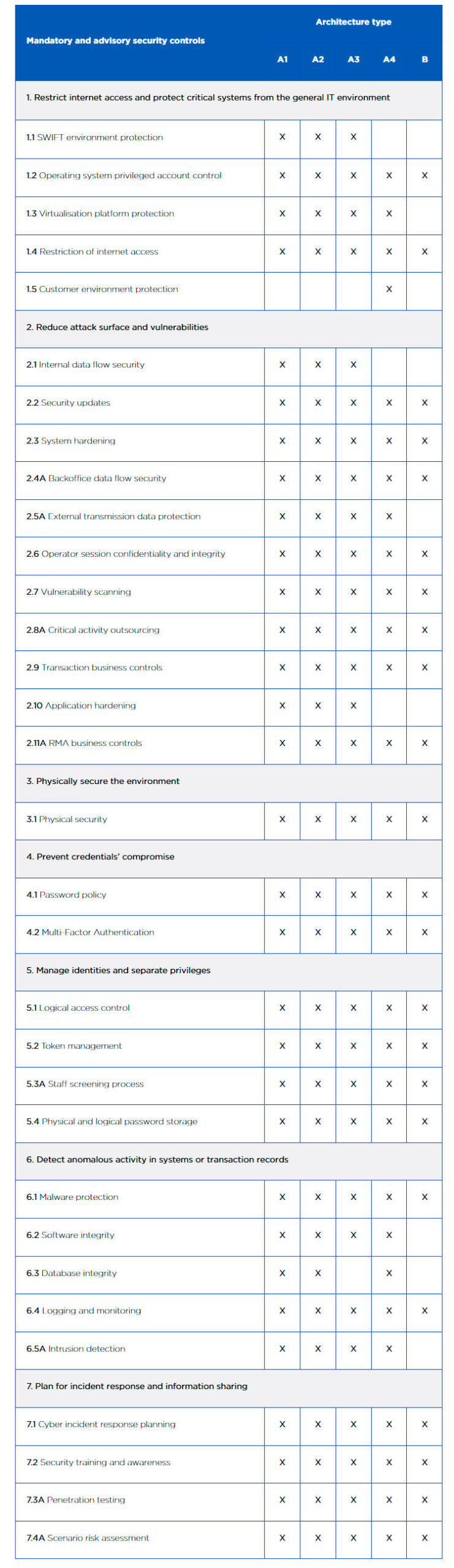
The following table offers a comprehensive summary of all mandatory and advisory security controls (a total of 32), organised by the guiding principle they adhere to and linked to the specific architecture model they apply to:
The CSP has significantly enhanced the security posture of individual institutions and the broader financial ecosystem. It has led to reduced risks of fraudulent transactions and fostered a culture of transparency.
Despite these improvements, a few security incidents still occurred within the SWIFT system, namely:
Nevertheless, the positive impact of the CSP is undeniable: by sharing attestation data, SWIFT users create a peer-driven momentum towards better security practices, contributing to a safer financial environment for all.
The future of the CSP is intertwined with the rapid evolution of technology and the shifting landscape of cyber threats. To address these evolving threats, the CSP’s future strategy will likely incorporate several key adaptations:
By embedding these strategies, the CSP can enhance its resilience and continue to safeguard the global financial system effectively.
The CSP has been decisive in strengthening the financial industry's defenses against cyber threats. It emphasises the importance of collaboration and compliance with security controls to maintain the integrity of the global financial system. As we look to the future, the CSP will continue to evolve, addressing new challenges and ensuring the financial ecosystem remains secure.
Financial institutions are encouraged to regularly review and update their cybersecurity practices in line with the latest version of the CSCF. Engaging with SWIFT’s community for shared learning and improvement is vital for staying ahead of potential threats and safeguarding the global financial system.
SWIFT (Society for Worldwide Interbank Financial Telecommunication) is a global member-owned cooperative that provides secure financial messaging services to financial institutions worldwide. It facilitates fast, accurate, and secure communication for transactions, including payments, securities, and treasury operations.
The Customer Security Programme (CSP), launched by SWIFT in response to a wave of sophisticated cyberattacks before 2016, aimed to improve the cybersecurity posture of users worldwide. These complex and diverse cyber threats highlighted the critical need for a unified security approach across the financial sector.
The CSP introduced the Customer Security Controls Framework (CSCF) to establish mandatory and advisory security measures for all SWIFT users. This initiative marks SWIFT’s dedication to strengthening the security and resilience of the global financial ecosystem against cyber threats, ensuring the integrity and reliability of international financial transactions.
The CSCF outlines mandatory and advisory security controls for SWIFT users, grounded in industry-standard frameworks like NIST, ISO 27000, and PCI-DSS. Mandatory controls set a security baseline, while advisory controls, based on best practices, are recommended for additional protection.
The CSCF’s design reflects a proactive approach to cybersecurity, as shown in the image below. The security measures are founded on three primary objectives of the framework:
Objective 1: Secure your environment:
Objective 2: Know and limit access:
Objective 3: Detect and respond:
The CSCF specifies 5 main architecture types that dictate which security controls are applicable based on the SWIFT components and infrastructure an organisation uses. These architecture types, defined by the ownership and deployment of SWIFT-specific infrastructure components, help organisations identify the scope of their required cybersecurity measures within the CSP framework. Here are the outlined architecture types:
SWIFT users are required to attest compliance with the CSCF’s controls via the KYC Security Attestation (KYC-SA) application. This process underscores the shared responsibility of SWIFT and its users in maintaining a secure network. Despite challenges, the financial community has been successful in implementing these controls, with ongoing dialogue and feedback helping to refine and improve the CSP.
The following table offers a comprehensive summary of all mandatory and advisory security controls (a total of 32), organised by the guiding principle they adhere to and linked to the specific architecture model they apply to:
The CSP has significantly enhanced the security posture of individual institutions and the broader financial ecosystem. It has led to reduced risks of fraudulent transactions and fostered a culture of transparency.
Despite these improvements, a few security incidents still occurred within the SWIFT system, namely:
Nevertheless, the positive impact of the CSP is undeniable: by sharing attestation data, SWIFT users create a peer-driven momentum towards better security practices, contributing to a safer financial environment for all.
The future of the CSP is intertwined with the rapid evolution of technology and the shifting landscape of cyber threats. To address these evolving threats, the CSP’s future strategy will likely incorporate several key adaptations:
By embedding these strategies, the CSP can enhance its resilience and continue to safeguard the global financial system effectively.
The CSP has been decisive in strengthening the financial industry's defenses against cyber threats. It emphasises the importance of collaboration and compliance with security controls to maintain the integrity of the global financial system. As we look to the future, the CSP will continue to evolve, addressing new challenges and ensuring the financial ecosystem remains secure.
Financial institutions are encouraged to regularly review and update their cybersecurity practices in line with the latest version of the CSCF. Engaging with SWIFT’s community for shared learning and improvement is vital for staying ahead of potential threats and safeguarding the global financial system.