How we impact
act PROSPERI.AI
Act Digital Corporate Artificial Intelligence
Solutions
Services
Partners
Imagine having a virtual replica of yourself, which you could use to simulate reactions or outcomes of certain behaviours, before testing them out in real life. Useful, right? Now project that to a business level. What if you could have a digital copy of a product your company is working on to test its behaviour in different scenarios and understand how it could be optimised?
Well, it is possible to access that enterprise metaverse thanks to digital twin technology. Let’s deconstruct this concept and see how it can help businesses achieve a strategic advantage.
A digital twin is a virtual copy of a physical object, system, or process, used to create simulations that help predict behaviour and make better-informed decisions about performance and maintenance.
Here’s a simplified representation of how it works:
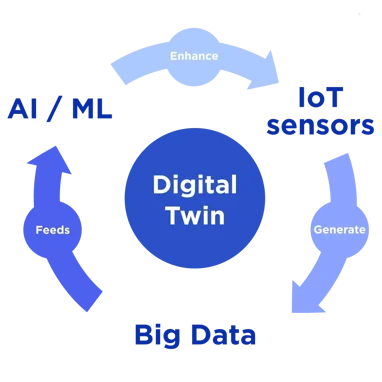
That is to say that this technology relies mainly on:
Both are virtual models that intend to reproduce reality, but the difference between them is fundamentally a matter of scale.
A simulation is a much more simplified model, commonly used to study one specific scenario, because it does not feed on real-time data.
A digital twin, on the other hand, is a much more complex virtual environment, which can continuously learn from data and create a vast number of simulations to study different scenarios.
The digital twin technology is being widely adopted across several sectors, especially those focused on large-scale products:
… Google Earth and Google Maps are two of the most notorious examples of digital twins. They both replicate the Earth’s surface in near-real time.
Imagine you’re going from point A to point B and open Google Maps to check out the best route. It then processes real-time traffic data gathered from IoT devices (like cars with GPS capabilities), mapping out the fastest route at that particular time.
There are different types of digital twins, depending on the scale of the product they are trying to replicate and the area of application. They can co-exist within the same system:
Digital twin technology can help businesses increase productivity, innovation, and competitiveness. Here’s how:
Before anything else, certain conditions must be met, namely:
Then, developing a digital twin for your business usually involves 6 steps:
Ideally, an organisation would start with one digital twin and then work its way up to several interconnected digital twins – depending on what makes sense for each company/industry.
While digital twins may provide a handful of benefits, they also face quite a few challenges that most of the AI and IoT technologies do, like:
Despite these challenges, the future still looks promising for digitals twins. As AI, ML and Cloud Computing technologies mature and evolve, creating digital twins to support businesses will become a more accessible and cost-effective solution. Performance-wise, the sky is the limit since digital twins are constantly learning from data and developing new capabilities.
According to the renowned ScienceDirect, “more and more industries are actively using digital twin solutions for asset and product lifecycle management”, so “it is predicted that the technology will expand to more use cases, applications, and industries” in upcoming years.
Imagine having a virtual replica of yourself, which you could use to simulate reactions or outcomes of certain behaviours, before testing them out in real life. Useful, right? Now project that to a business level. What if you could have a digital copy of a product your company is working on to test its behaviour in different scenarios and understand how it could be optimised?
Well, it is possible to access that enterprise metaverse thanks to digital twin technology. Let’s deconstruct this concept and see how it can help businesses achieve a strategic advantage.
A digital twin is a virtual copy of a physical object, system, or process, used to create simulations that help predict behaviour and make better-informed decisions about performance and maintenance.
Here’s a simplified representation of how it works:
That is to say that this technology relies mainly on:
Both are virtual models that intend to reproduce reality, but the difference between them is fundamentally a matter of scale.
A simulation is a much more simplified model, commonly used to study one specific scenario, because it does not feed on real-time data.
A digital twin, on the other hand, is a much more complex virtual environment, which can continuously learn from data and create a vast number of simulations to study different scenarios.
The digital twin technology is being widely adopted across several sectors, especially those focused on large-scale products:
… Google Earth and Google Maps are two of the most notorious examples of digital twins. They both replicate the Earth’s surface in near-real time.
Imagine you’re going from point A to point B and open Google Maps to check out the best route. It then processes real-time traffic data gathered from IoT devices (like cars with GPS capabilities), mapping out the fastest route at that particular time.
There are different types of digital twins, depending on the scale of the product they are trying to replicate and the area of application. They can co-exist within the same system:
Digital twin technology can help businesses increase productivity, innovation, and competitiveness. Here’s how:
Before anything else, certain conditions must be met, namely:
Then, developing a digital twin for your business usually involves 6 steps:
Ideally, an organisation would start with one digital twin and then work its way up to several interconnected digital twins – depending on what makes sense for each company/industry.
While digital twins may provide a handful of benefits, they also face quite a few challenges that most of the AI and IoT technologies do, like:
Despite these challenges, the future still looks promising for digitals twins. As AI, ML and Cloud Computing technologies mature and evolve, creating digital twins to support businesses will become a more accessible and cost-effective solution. Performance-wise, the sky is the limit since digital twins are constantly learning from data and developing new capabilities.
According to the renowned ScienceDirect, “more and more industries are actively using digital twin solutions for asset and product lifecycle management”, so “it is predicted that the technology will expand to more use cases, applications, and industries” in upcoming years.