
How we impact
act PROSPERI.AI
Act Digital Corporate Artificial Intelligence
Solutions
Services
Partners
Every corporation provides critical services through its applications, meaning they cannot suffer any disruption in their operation. Software testing is responsible for optimising the management of these resources in order to anticipate possible failures that may arise for end users. Tests can be carried out by developers or by specialised professionals like Quality Assurance (QA) specialists.
Let's find out more about software testing and its role in the success of a product.
According to the International Software Testing Qualifications Board (ISTQB), levels of testing are groups of testing activities organised and managed together, with each level being equivalent to an instance of the testing process.
There are the following levels of testing:
The types of testing represent a group of activities focused on testing specific characteristics of the system, or part of the system based on its objectives. They are subdivided into:
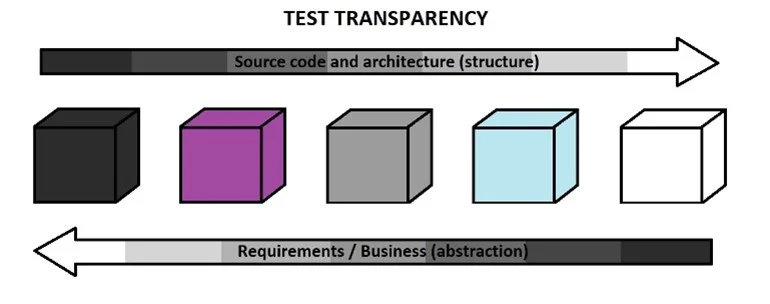
The greater the visibility of the code, the greater the visibility of how the feature is made, the smaller the quantities of requirements and business specifications tested, and the greater the transparency of the test, approaching a white box test. On the other hand, the lower the visibility of the code, the lower the visibility of how the feature is made, the higher the quantities of requirements and business specifications, and the lower the transparency of the code, gradually approaching a black box test. The image below illustrates this idea.
Any of the levels and types of software testing mentioned above can be carried out in two ways:
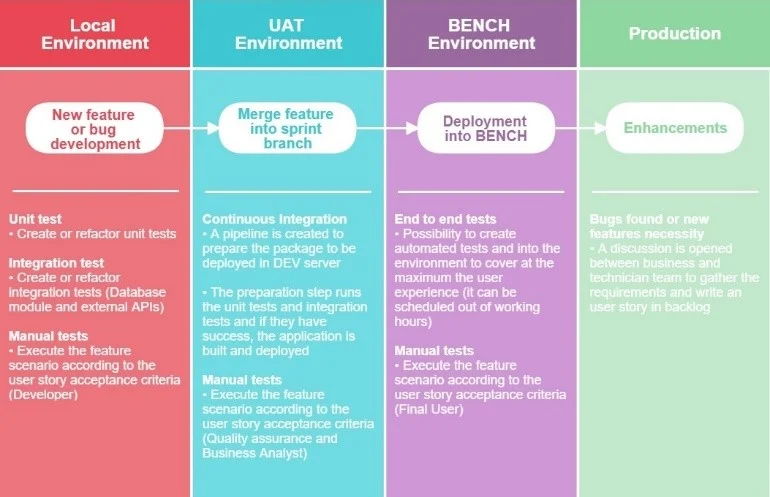
Each type of test can be applied in different environments, where the applications are installed, and in different development phases according to the infrastructure, needs and budget of each project/application, as shown in the image below.
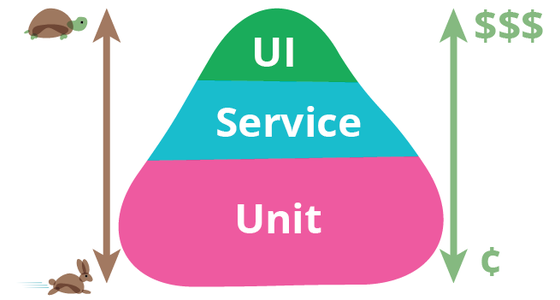
Usually, the amount of unit tests developed is relatively greater than that of integration tests (also called service tests) and UI tests (included in the level of system tests), because they cost less, are less specific and are quicker to develop.
This logic is illustrated by the software testing pyramid:
Among the most common software tests developed are unit tests, integration tests and sometimes UI tests. Different levels of testing are created, taking into account their particularities:
In order to deliver a high-quality product at a low cost and with little time invested, a combination of tests should be considered, considering that they can be carried out manually or automatically. However, the types of tests and quantity to be developed depend on the application's scalability, budget, project time and product needs.
Every corporation provides critical services through its applications, meaning they cannot suffer any disruption in their operation. Software testing is responsible for optimising the management of these resources in order to anticipate possible failures that may arise for end users. Tests can be carried out by developers or by specialised professionals like Quality Assurance (QA) specialists.
Let's find out more about software testing and its role in the success of a product.
According to the International Software Testing Qualifications Board (ISTQB), levels of testing are groups of testing activities organised and managed together, with each level being equivalent to an instance of the testing process.
There are the following levels of testing:
The types of testing represent a group of activities focused on testing specific characteristics of the system, or part of the system based on its objectives. They are subdivided into:
The greater the visibility of the code, the greater the visibility of how the feature is made, the smaller the quantities of requirements and business specifications tested, and the greater the transparency of the test, approaching a white box test. On the other hand, the lower the visibility of the code, the lower the visibility of how the feature is made, the higher the quantities of requirements and business specifications, and the lower the transparency of the code, gradually approaching a black box test. The image below illustrates this idea.
Any of the levels and types of software testing mentioned above can be carried out in two ways:
Each type of test can be applied in different environments, where the applications are installed, and in different development phases according to the infrastructure, needs and budget of each project/application, as shown in the image below.
Usually, the amount of unit tests developed is relatively greater than that of integration tests (also called service tests) and UI tests (included in the level of system tests), because they cost less, are less specific and are quicker to develop.
This logic is illustrated by the software testing pyramid:
Among the most common software tests developed are unit tests, integration tests and sometimes UI tests. Different levels of testing are created, taking into account their particularities:
In order to deliver a high-quality product at a low cost and with little time invested, a combination of tests should be considered, considering that they can be carried out manually or automatically. However, the types of tests and quantity to be developed depend on the application's scalability, budget, project time and product needs.